
26 Oct 2026
The tools would be unrecognizable (The job would not)
Put a tester from 2015 in front of a 2026 test suite and most of it would look foreign. Playwright has replaced Selenium on the newer builds. An AI assistant drafted half the tests, a self-healing locator quietly repaired the other half overnight, and an agent has been exploring the checkout flow on its own since lunch.
Now ask that same tester what the suite is for, and nothing has changed. Someone still has to decide what matters, work out what "correct" means, find the failure nobody expected and explain it clearly enough that it gets fixed. That is the discipline, and it has outlived every tool it has ever used.
This article is about both halves: how the tooling has moved, from Selenium to AI, and which qualities in a traditional tester are worth holding on to, and hiring for, as it moves again.
How the tools got here
Test automation has been through three generations in twenty years, and each one has moved the human a step further from the keystroke.
Scripted automation (2004 to about 2018): Selenium began in 2004 as a side project at ThoughtWorks and became the standard way to drive a browser; by 2018 its WebDriver protocol was a W3C recommendation. A tester wrote every click, wait and assertion, and much of the craft went into keeping locators stable and page objects tidy. Commercial tools such as QTP/UFT and Tosca offered record-and-playback and model-based alternatives for large enterprises.
Developer-grade frameworks (2018 to 2023): Cypress and then Microsoft's Playwright made automation feel like ordinary software engineering: auto-waiting, built-in tracing, parallel runs with no grid to manage. Testing moved into the pull request, next to unit, API and contract tests. For new web projects in 2026 Playwright is the usual default, while Selenium is still maintained and still anchors large existing suites, particularly in Java estates.
AI-assisted and agentic (2023 onwards): The current generation does not just run tests; it writes and repairs them. Coding assistants draft unit and API tests from a prompt. Playwright now ships three test agents: a planner that explores the application and writes a plan in plain Markdown, a generator that turns the plan into runnable tests, and a healer that replays a failing test and patches its locators or waits (Playwright docs). Commercial platforms go further, with natural-language test authoring, visual AI for layout checks and autonomous agents that explore an application on their own.
The adoption figures say this is mainstream, not fringe. The World Quality Report 2025-26, based on more than 2,000 senior executives across 22 countries, found 89% of organisations piloting or deploying Gen AI in quality engineering. Only 15% had scaled it across the enterprise, and the reported productivity gain averaged 19%.
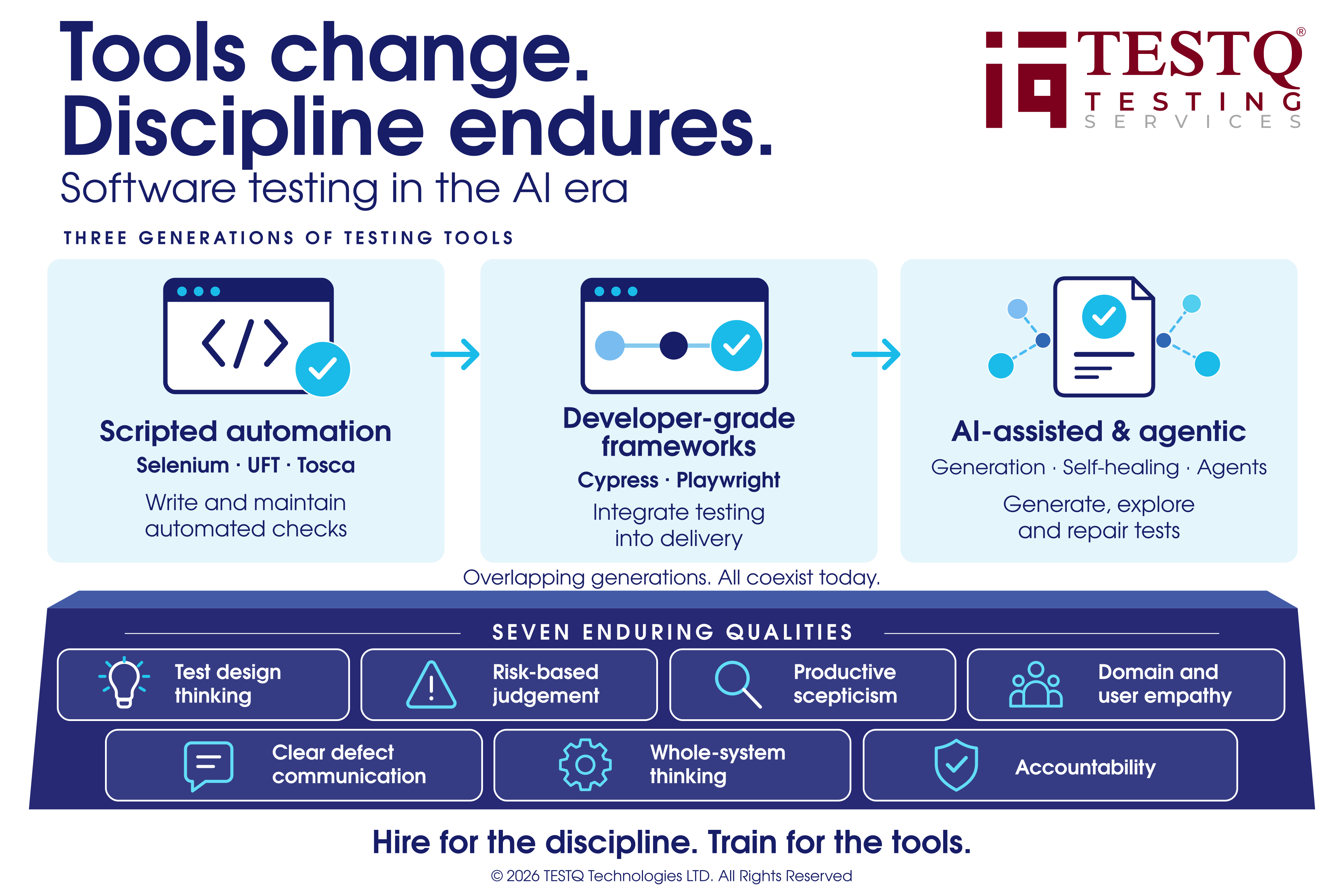
Three tool generations on one discipline layer
The top row has turned over three times since 2004. The band underneath has not changed, and each generation of tooling has rested on it.
What AI changes, and what it cannot do
AI changes the economics of testing more than its purpose. Three shifts are already visible in teams that have adopted it seriously.
Two things do not change, because they are not tooling problems. The first is the oracle problem: a tool can execute a check, but it cannot know what the right answer is unless someone tells it. A generated assertion that checks what the application currently does will happily lock in a bug as expected behaviour. Playwright's own healer illustrates the risk: its documented output is either a passing test or a skipped one, and a person has to review which of those is the truth.
The second is that AI output is plausible by design. A fluent test plan looks finished whether or not it covers the right risks, which makes an unreviewed plan more dangerous than an obviously rough one. The World Quality Report found hallucination and reliability concerns were a top challenge for 60% of respondents, and that half of organisations still report a lack of AI and machine-learning expertise.
There is also a new category of work: testing systems that are themselves AI. A chatbot or a recommendation engine does not return the same answer twice, so pass/fail gives way to evaluation sets, thresholds and sampled review. That is a testing problem, and testers are the people best placed to own it.
Seven qualities worth cherishing in a traditional tester
The qualities below were the mark of a good tester in the Selenium years, and every one of them is worth more now, not less, because AI produces volume and someone has to supply judgement.
None of these is a tool skill. They are habits of mind, built over years of looking at software that was supposed to work and did not.
What to add to the toolkit
Cherishing the old skills is not an excuse to skip the new ones. The testers who will do best over the next five years are adding four things to the discipline they already have.
The pattern is consistent: each new skill sits on top of an old one. Prompting well is test design. Reviewing generated tests is productive scepticism. Evaluating AI systems is the oracle problem again, with statistics attached.
A note for hiring managers, and for testers
Hire for the discipline and train for the tools. A tool can be learnt in a quarter; the seven qualities above take years and show up in how a candidate talks about a bug they found, not in the list of frameworks on their CV.
For hiring managers, three practical suggestions:
For testers, the advice is the mirror image. Keep the habits that made you good, pick up the tooling without fear, and get comfortable reviewing other people's tests, including the ones written by a machine. The title on the job spec may change to quality engineer or AI evaluation specialist; the work underneath is the work you already know.
Conclusion
Selenium did not make testers redundant; it made good testers more valuable, because it let them spend their judgement where it was needed. AI is doing the same thing at a larger scale and a faster pace. The tools will change again, probably before this article is a year old. The discipline underneath them is the part worth investing in.
Or, as OpenText's Tal Levi-Joseph put it when the World Quality Report was launched: "AI amplifies capability, but it cannot substitute for it."
TESTQ Technologies helps UK and European organisations find testers and quality engineers who bring that discipline, whatever the toolchain. To talk about your testing team, contact us at testq@testqtech.com.
Don't forget to share this post!
Sources

Dhananjay Patil
Dhananjay Patil, Director of TESTQ Technologies, possesses extensive experience in both automated and manual software testing, as well as in quality processes and systems. He has contributed to projects across various development methodologies, industry verticals, and technical platforms.